

“If you listen to your body and mind when they whisper, you won’t have to hear them scream.”
When it comes to caring for our emotional wellness this saying couldn’t be more true. To truly manage and support your wellbeing you first need to recognise when you’re becoming emotionally unwell.
Part of this means being able to identify and name the emotions you’re experiencing, something I’ve explored more deeply in my Insight Are You Emotionally Well? The other part is learning to notice the signs, paying attention to how they show up in yourself (in your body, your thoughts, your behaviour) and then doing something about it.
Recognising when you’re becoming emotionally unwell isn’t about diagnosing yourself or obsessing over what’s ‘wrong’. It’s about listening to those early whispers and doing something about them before they turn into screams.
Because when we catch those signs early we can stop our mental health worsening.
Research by the Mental Health Foundation proves that early intervention is the best way to prevent our emotional wellness escalating to a crisis.
Emotional Wellness is on a Continuum:
In psychology emotional wellness is understood as existing on a continuum, or a spectrum. Its is not something you either have or don’t have.
Think of it as a sliding scale, not an on/off switch:
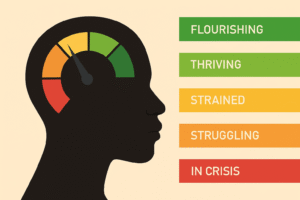
As Dr Alex George explains in his book, The Mind Manual, at one end of the spectrum is depression, anxiety and emotional distress- times when we feel extremely low, overwhelmed and unable to cope. At the other end of the spectrum we experience emotional strength, balance and abundance, moments when we feel at peace, grounded and aligned with our purpose.
Most of us move up and down this continuum throughout our lives, and that’s perfectly normal.
Feeling emotionally unwell from time to time doesn’t mean you’re broken. It means you’re human.
The more we understand this, the easier it becomes to show ourselves compassion when things feel heavy, and the better we get at drawing for the tools and support that can help us return to the thriving part of the scale.
Why Noticing Early Matters:
When we ignore the signs of being emotionally unwell, like the tiredness that never quite lifts, the irritability we brush off or the disconnection we feel but can’t name- we give distress time to deepen.
Learning to recognise the early signs of emotional unwellness gives us chance to pause, to care for ourselves, to get support and to make changes before we slip into the crisis zone.
Recognising we are becoming emotionally unwell isn’t about becoming fixated on the why. The why can often take some time to understand. What matters first is noticing how we are being affected, how it’s showing up in our daily lives.
Maybe your body feels heavy. Maybe your struggling to sleep. Maybe your usual joy feels dimmer.
Listening early and focussing on the impact, not just the cause, can helps us to identify what we need and what steps to take in order to turn up our emotional wellness gauge, before we slide into struggle or even crisis.
In her book The Unapologetic Guide to Black Mental Health, Dr Rheeda Walker shares a powerful analogy that explains the consequences of not taking action early to improve our emotional wellness:
The Frog in a Pot

If you put a frog in a pot of tepid water, which is then brought to boil, slowly, it will not notice the heat increasing or feel the danger.
Instead, the frog will stay in the pot and adjust to the increasing temperature until the water eventually boils.
And the frog is boiled to death.
Don’t be a frog in the pot.
Recognise the rising heat of emotional unwellness before it overwhelms and pulls you into crisis.
Notice the heat. Step out. Cool down.
Care for yourself before you boil.
𓋹 Make a change:
Take a moment to reflect on what being emotional unwell looks like for you, and then create an ‘early signs’ list.
Do you withdraw from others? Struggle to focus? Find your sleep or energy changing? Split your ‘early signs’ list into three parts:
- Mind signs- what shifts do you notice in your thoughts? (examples might be racing thoughts, mood swings, feeling irritable)
- Body signs- how does your body feel when you’re not at your best? (examples might be pounding heart, sweaty palms, skin rashes)
- Behaviour signs- which of your actions or habits start to change? (examples might be overeating or undereating, fidgeting, neglecting self-care)
Keep your list somewhere visible, so you can refer to it. Let it become your personal early-warning system, a gentle reminder to act with care before things spiral.
Why We Don’t Always Recognise we are Becoming Emotionally Unwell:
Even when we know the signs, recognising them in ourselves can be the hardest part. Sometimes we’re too busy caring for everyone else, showing up for family, friends and work, that we forget to check in with ourselves, with how we are really feeling. Other times we’ve simply learned to ‘keep it moving’, and we ignore the fact we are feeling emotionally unwell.
For many of us stress has become so normal that it has become the background music of our lives. We call it: “just being tired”, “just a rough week” or “just life”. But over time what we normalise can begin to wear us down.
In many Black families and communities, normalising, and even ignoring, poor emotional health runs deep. Strength has often been defined as never breaking, as holding it all together, no matter the cost. Too many of us have learned to smile through struggle, to say “I’m fine”, even when we’re not.

But real strength isn’t about pretending everything is okay. Real strength is having the courage to pause, to breathe, to admit when we’re not okay and to reach for what we need.
As Dr Rheeda Walker reminds us:
“Because emotional problems do not shut us down, we keep going, despite the potential long-term consequences.”
However, just because we can keep going doesn’t mean we should keep going.
The sooner we recognise our signs and honour our limits the more space we create for healing, rest and developing true resilience.
𓋹 Make a Change:
Speak your truth out loud.
Many of us were taught to keep our struggles to ourselves.
Make a change this week and share one honest feeling that has left you feeling emotionally unwell with someone you trust.

Start small.
Identify the feeling, choose the person you will share this with and then plan when you will share it, for example: “I’ve been feeling drained this week” or “I’m finding it hard to stay motivated.”
The person doesn’t need to fix the problem or offer a solution, that’s not the point. The point is to give voice to what you’ve been holding in and to remind yourself that you don’t have to carry it alone.
Speaking your truth is an act of strength, not weakness. It’s a step toward freedom and healing.
Common Signs You’re Becoming Emotionally Unwell:
You might be moving toward emotional unwellness if you notice things like:
- Feeling easily overwhelmed by tasks that used to feel manageable.
- Finding it harder to focus or make simple decisions.
- Withdrawing from friends, family, or social spaces you normally enjoy.
- Becoming unusually irritable or sensitive.
- Sleeping too much or too little.
- A persistent sense of “flatness” or lack of motivation.
- Feeling like you’re just “getting through” the days.
Common Signs You’re Already Emotionally Unwell:
When things progress further, you might experience:
- Feeling numb or detached from reality.
- Intense sadness or hopelessness that lingers.
- Frequent tearfulness or emotional outbursts.
- Extreme fatigue or loss of interest in things that once mattered.
- Persistent physical symptoms like headaches, stomach issues or tension.
- Thoughts of worthlessness or self-blame.
If these resonate, it’s important to seek professional or specialist support. There’s no shame in needing help just courage in reaching out.
Final Word:
Becoming emotionally unwell is part of being human. It doesn’t make you abnormal, weak, or broken. It means your emotional system needs attention and care.
What’s your mind whispering right now?
Salute to the Sources:

Deep gratitude to the thought leaders, creators and cultural voices who was used in this reflection:
- Main image: Photo by Mental Health America on Pexels
- Dr Alex George, The Mind Manual, for his compassionate framing of mental health as a continuum and reminder that balance is something we move toward, not a fixed state
- Dr Rheeda Walker, The Unapologetic Guide to Black Mental Health — for naming the cultural realities of strength, silence, and survival in Black communities, and for offering a language of courage, awareness and truth-telling.
- Woman holding her head Photo by Baptista Ime James on Unsplash
- Woman on her phone Photo by by Natasha Hall on Unsplash